
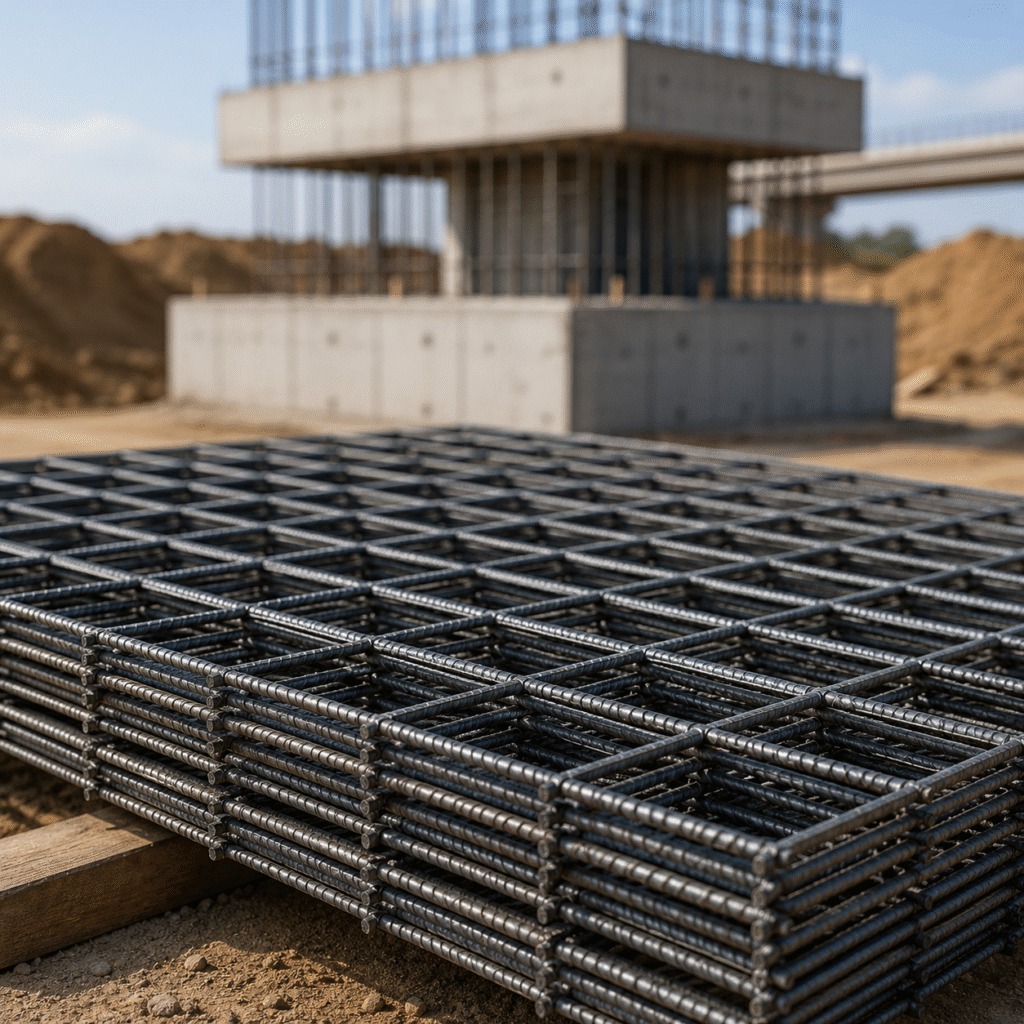
Custom rebar mesh has become an important reinforcement solution for infrastructure projects where speed, repeatability and placement accuracy matter. In bridge deck reinforcement, tunnel lining support and highway pavement construction, the main value is not only the steel itself, but the way prefabricated mesh reduces site work and keeps reinforcement geometry under better control.
Table of Contents
- Why infrastructure projects use custom mesh
- Key technical parameters
- Application comparison
- Common specification mistakes
- Supplier and bulk purchasing considerations
Industry Background: Why Reinforcement Prefabrication Matters
Infrastructure construction often works under tight traffic windows, limited site access and strict inspection requirements. Traditional loose rebar tying is flexible, but it also depends heavily on field labor, weather conditions and installation sequence.
Custom steel mesh changes part of that work from the jobsite to the processing plant. Bars are cut, spaced and welded or assembled according to drawings before delivery. For contractors, this means fewer loose components, faster placement and more predictable inspection before concrete pouring.
In large projects, minutes saved per panel or cage can become meaningful. A bridge deck with repeated reinforcement zones, or a tunnel lining with curved support sections, benefits from consistent mesh modules that fit the design without excessive trimming.
Technical Factors That Affect Performance
A good specification should explain how the mesh will perform in concrete, not just list bar diameter and spacing.
| Specification Item | Practical Meaning | Effect on Construction |
| Bar diameter | Steel area per direction | Controls tensile capacity and crack behavior |
| Bar spacing | Distance between longitudinal and transverse bars | Affects crack distribution and concrete flow |
| Mesh panel size | Delivered module dimension | Influences lifting, storage and placement speed |
| Weld or connection quality | Stability of intersections | Keeps bars aligned during handling and pouring |
| Steel grade | Yield strength and ductility | Must match structural design and local standards |
| Cover requirement | Distance from steel to concrete surface | Affects durability and corrosion protection |
For example, tighter spacing may improve crack distribution in bridge decks, but it can also make concrete consolidation more difficult if the mix is dense or the cover is limited. Larger spacing may speed up placement, but it must still satisfy the engineer’s steel area and crack control requirements.
Application Comparison
Bridge Deck Reinforcement
Bridge decks are exposed to repeated traffic loads, vibration, water and deicing salts in many regions. Reinforcement placement must be accurate because cover depth affects long-term durability. Custom rebar mesh helps reduce layout variation by delivering repeated mats that match the deck zone.
For bridge deck reinforcement, engineers often pay close attention to lap length, top and bottom mat position, corrosion protection and support chairs. A well-prepared mesh package should arrive with clear bundle identification so the site team can place each section in the right order.
Tunnel Lining Support
Tunnel lining support has a different challenge. Reinforcement may need to follow curved geometry, fit around rock bolts, or work with shotcrete or cast concrete lining systems. Mesh that is too rigid or incorrectly curved can slow installation underground, where working space is limited.
Custom rebar mesh for tunnels should consider radius, panel width, overlap direction and handling weight. In some projects, smaller modular panels are more efficient than large sheets because crews can position them safely in confined areas.
Highway Pavement Construction
In highway pavement construction, reinforcement is often used to control cracking, improve load transfer and support long service life. For long paving sections, mesh consistency matters because uneven spacing or poor elevation can lead to variable performance.
Bulk supply planning is also important. If mesh panels arrive in mixed bundles without clear labels, paving crews may lose time sorting materials. For road projects, packaging and delivery sequence can affect productivity almost as much as steel price.
Common Specification Mistakes
One mistake is treating custom mesh as a simple commodity. Two mesh panels may look similar, but different bar grades, weld quality, spacing tolerances and bundle conditions can create very different site results.
Another mistake is ordering the largest possible sheet size to reduce overlaps. In theory this reduces joints. In practice, oversized panels may be difficult to unload, lift, rotate or place safely, especially on bridges or inside tunnels.
A third issue is ignoring constructability. A drawing may be structurally correct, but if it cannot be fabricated, bundled or installed efficiently, the project will face delays. Good mesh design should involve both structural engineering and processing knowledge.
Performance and Buying Considerations
When comparing a bulk rebar processing price, buyers should look beyond price per ton. Cutting accuracy, welding consistency, bar straightness, labeling, packing and delivery reliability all affect the real project cost.
An industrial rebar supplier or custom steel mesh manufacturer should be able to discuss drawing conversion, bar schedules, tolerance control, loading method and inspection documents. For infrastructure projects, repeatability is usually more valuable than a small saving on the first order.
Before purchasing, confirm:
- Applicable steel standard and grade
- Bar diameter, spacing and panel dimensions
- Flat, bent or curved mesh requirement
- Lap, cover and support details
- Bundle weight and lifting method
- Delivery sequence by project zone
- Inspection records and material certificates
Final Practical View
Custom rebar mesh accelerates infrastructure construction because it reduces uncertainty. It moves repetitive measuring, cutting and spacing work into a controlled processing environment, leaving the site team to focus on placement, alignment and concrete quality.
For bridges, tunnels and highways, the right mesh is not simply the cheapest steel. It is the reinforcement package that fits the drawing, arrives in the correct sequence, handles safely on site and helps the concrete structure perform as designed.