
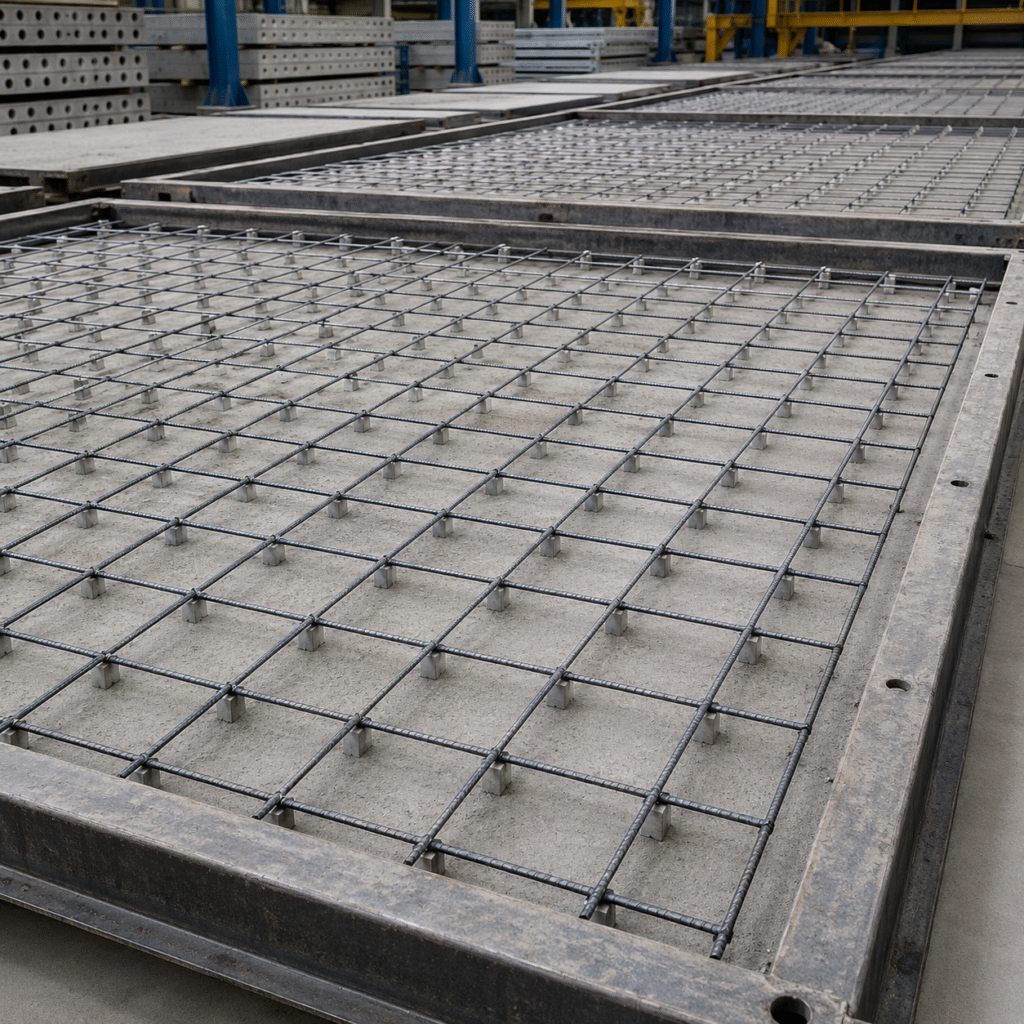
Welded wire fabric for concrete is not simply a grid of steel wire. In precast concrete panels, floor slab construction, and residential building structures, it controls crack width, improves reinforcement consistency, and helps factories and contractors keep placement work predictable.
Table of Contents
- Why welded wire reinforcement matters
- Key specification factors
- Application comparison
- Common selection mistakes
- Buying and supplier considerations
Industry Background: Why WWR Is Widely Used
Concrete performs well under compression but needs steel reinforcement to manage tensile stress, shrinkage, and service cracking. Welded wire reinforcement (WWR), also called concrete reinforcement mesh or reinforcing steel fabric, gives designers a regular reinforcement pattern that is easier to position than loose bars in many panel and slab applications.
For precast manufacturers, repeatability is often as important as strength. A panel line may produce hundreds of similar wall panels, floor panels, or façade elements. Using standardized welded mesh sheets can reduce manual tying, shorten cage preparation time, and help maintain dimensional consistency from one batch to the next.
How Technical Parameters Affect Performance
A useful specification should not stop at “wire diameter and mesh opening.” Each parameter affects how the finished concrete element behaves and how efficiently it can be produced.
| Parameter | Practical Meaning | Why It Matters |
| Wire diameter | Cross-sectional steel area | Affects tensile capacity and crack control |
| Mesh spacing | Distance between wires | Influences crack distribution and concrete flow |
| Sheet size | Overall panel dimensions | Impacts cutting waste and installation speed |
| Plain or deformed wire | Surface bond condition | Affects anchorage and load transfer |
| Weld quality | Strength of intersections | Keeps reinforcement geometry stable during handling |
| Surface condition | Black, galvanized, or coated options | Affects corrosion resistance in specific environments |
For example, a smaller wire spacing can distribute reinforcement more evenly across a thin precast panel. However, if the spacing is too tight, concrete flow around the mesh may become more difficult, especially with dense mixes or narrow panel sections. On the other hand, larger openings can make placement easier but may provide less refined crack control.
Application Comparison
Precast Concrete Panels
In precast concrete panels, reinforcing steel fabric is often selected for dimensional control and fast assembly. Sheets can be cut or bent according to panel geometry, openings, lifting anchor zones, or edge reinforcement requirements. The main advantage is repeatability: once the mesh style is approved, the production team can follow the same reinforcement layout across many panels.
Floor Slab Construction
For floor slabs, welded wire reinforcement is commonly used to limit crack width and hold cracked concrete sections together. The key issue is position. If mesh is left at the bottom of the slab or pulled up after concrete placement, its performance becomes unreliable. Proper chairs, supports, or placement methods should be considered during specification, not after the concrete truck arrives.
Residential Building Structures
In residential building structures, concrete reinforcement mesh is frequently used in slabs, walls, driveways, and light structural elements. Buyers often focus only on price per sheet, but a more useful comparison includes wire area, sheet flatness, bundle weight, cutting loss, and how easily the mesh can be handled on site.
Common Specification Ranges
| Application Area | Common Selection Focus | Buying Consideration |
| Thin precast wall panels | Flatness, spacing accuracy, crack control | Sheet tolerance and handling stability |
| Ground-supported slabs | Steel area and correct elevation | Supports and overlap details |
| Residential slabs | Cost, availability, easy installation | Standard sheet sizes and local code needs |
| Industrial floors | Higher load and crack control demand | Engineer-approved WWR style |
| Panel factories | Repeatability and processing efficiency | Bulk supply consistency |
These ranges should always be checked against project drawings, local codes, and the structural engineer’s design. A wholesale reinforcement mesh order should match the actual design intent, not just a familiar mesh description.
Frequent Mistakes in Selection
One common mistake is treating welded wire fabric as a universal replacement for rebar. It can be an efficient reinforcement solution, but only when the wire size, spacing, lap length, and placement method are appropriate.
Another issue is ordering mesh without confirming sheet size and transport conditions. Oversized sheets may reduce cutting waste in theory, but they can be difficult to load, unload, store, or place in confined precast production areas.
A third mistake is ignoring weld integrity. Poor welds may not be obvious at first glance, but they can reduce shape stability during bending, lifting, or concrete placement. For a reinforcing mesh supplier, consistent welding is not a cosmetic requirement; it is part of production reliability.
Choosing a Supplier for Bulk Orders
When buyers need to buy steel wire mesh in bulk, the supplier should be evaluated beyond unit price. Important checks include wire source control, drawing accuracy, welding consistency, sheet flatness, packaging method, and the ability to provide stable repeat batches.
A practical supplier discussion should include:
- Required standard or project specification
- Wire diameter and spacing
- Sheet or roll format
- Plain, deformed, galvanized, or coated requirement
- Bundle weight and loading method
- Cutting, bending, or custom sheet size needs
- Inspection and documentation requirements
For distributors and contractors buying wholesale reinforcement mesh, packaging is also important. Well-bundled sheets reduce deformation during transport and save labor during unloading.
Final Buying Consideration
Good welded wire fabric for concrete should make the reinforcement process more predictable. It should fit the drawing, stay stable during handling, support efficient placement, and provide the required steel area in the right location.
For precast concrete panels and slab construction, the best selection is rarely the cheapest mesh on paper. It is the mesh that matches engineering requirements, production workflow, site handling, and long-term concrete performance.